


If you’re seeking a new income stream for your restaurant, operators are finding success in the resilient business dining segment. Business diners are among the most profitable customers: they order more courses, purchase premium beverages, and often return with different clients or colleagues if they are happy with their first visit.
Business Dining Is Always in Season

Business meals are tools for relationship building, negotiations, and team cohesion, which means they are a necessity regardless of economic turbulence.
Data indicates that corporate dining remains a consistent revenue stream that outpaces consumer dining. For instance, Dinova’s data report shows business dining grew 5.6% in 2024 and continued with moderate 3.6% growth in January 2025 compared to January 2024, outpacing overall industry performance.
Serving this segment is a high-value opportunity for restaurant operators, albeit one that requires precision.
Serving the Corporate Customer

To cater to this discerning group, restaurant operators must focus on the following core areas to attract and retain business clients.
Atmospheres That Support Productive Conversations
The most important thing to remember is a business diner’s primary goal is to conduct a productive conversation. Your restaurant is the environment that supports this goal, which means every detail counts.
To break it down, here are features of your restaurant that necessitate special consideration.
Acoustics and Noise Levels
Naturally, background noise is a significant deterrent when attempting to engage in a productive conversation. Operators must ensure their dining spaces offer a level of privacy and quiet that allows for clear, uninterrupted dialogue. Well-spaced seating and a thoughtful music strategy that avoids loud or distracting selections are essential.
Seating and Layout
Seating arrangements for business meetings prioritize comfort and discretion. As we mentioned, ample space between tables is essential as it prevents eavesdropping and makes it easy for guests to navigate the space. Booths or private dining rooms are highly desirable for this level of built-in privacy. The lighting should also be functional, not just aesthetic, so that diners can read menus and documents without strain.
Professional Ambiance
The cleanliness and overall mood must align with a professional context. We recommend a pristine standard of cleanliness for all guest-facing areas of your restaurant and a polished appearance for all staff.
Time Is of the Essence
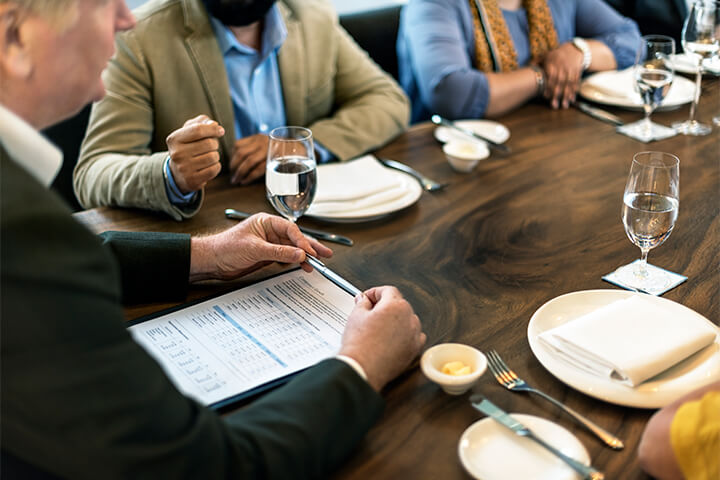
Business clients operate on strict schedules, always remembering that time is money. Any delay in the dining experience is a direct threat to their productivity, so operators need to be on their game.
Booking and Reservations
The reservation process must be straightforward and reliable. Operators should utilize digital reservation platforms that allow for special requests, such as a quieter table or a private room, to be noted in advance. Partitioned areas or reservable sections are especially useful for business clients.
Speed of Service
Service should be attentive and efficient without rushing or crowding the table. Business diners often have a hard stop and need to be in and out within a fixed time frame. Keep this in mind when they’re ordering. It helps to highlight items that can be prepared quickly. To avoid crowding the table, pay discreet attention to non-verbal cues to assess their needs.
Pacing of Service
Service must be prompt with minimal interruptions, but not rushed. Staff should be trained to “read the room” to understand when to approach the table for orders, check-ins, or the bill. There should also be no extended waits. This will immediately shake the confidence of the business diner.
Billing and Payment
This is a very important, often overlooked, aspect. The payment process must be discreet and efficient. The bill should be quietly presented in a folder and handled without public fanfare. For repeat clients, consider establishing dedicated corporate accounts to provide the smoothest checkouts. Pre-approved billing streamlines payment and encourages repeat use.
Keeping in mind that business meals are often reimbursed, offer expense-friendly billing. Itemized receipts, digital invoices, and integration with expense platforms minimize friction.
Specialized Service

Lastly, a business meal is not a leisurely affair; the establishment and menu should reflect this reality.
Menu Variety and Dietary Accommodations
The menu must be broad enough to accommodate various preferences and dietary restrictions without being overwhelming. Prominently featuring vegetarian, vegan, and gluten-free options is now a standard expectation. If your business model allows, prix-fixe business lunch menus and customizable group dining packages reduce decision time.
Overall Consistency and Professional Service
Service standards should explicitly include protocols for business diners for tasks like subtle check delivery or recognizing repeat corporate clients. Business diners expect servers to handle checks discreetly, manage pacing without disruption, and understand the nuances of professional dining (for example, not interrupting mid-pitch). Training staff to recognize and respect the dynamics of business dining is essential to retaining these clients.
Grow Revenue with Business Clients

Creating an ideal environment for business diners is a strategic way to grow your restaurant’s revenue. Once you’ve established your restaurant as a go-to spot, you can naturally extend these relationships into catering opportunities. Cultivating these professional relationships within your restaurant sets the stage for future growth and a strong, diversified business.
