
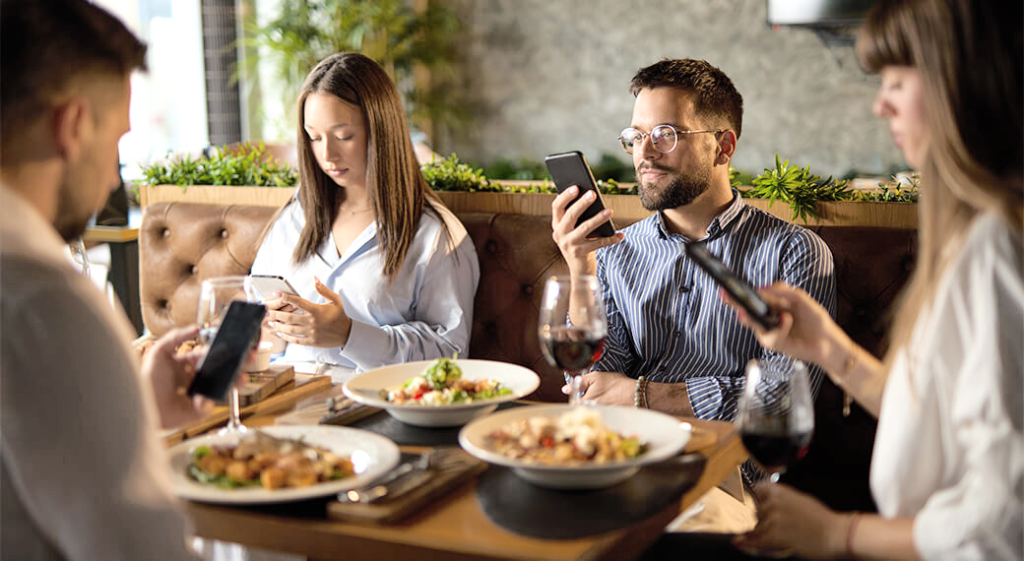

A growing number of restaurants and bars are implementing phone-free policies or providing incentives for guests to unplug. Younger diners are the biggest enthusiasts of this shift as they seek a well-earned break for their digital fatigue. In this article, we look at how restaurants are implementing their no-phone policies and explore the pros and cons of phone-free dining.
One Size Does Not Fit All

Around 12 US states now feature venues with active phone-restricting policies, a change most visible in large metropolitan areas. Washington, D.C. has become a leader in the movement, followed by Los Angeles, New York City, Dallas, Miami, and Las Vegas.
Restaurants are choosing different levels of enforcement, depending on their vibe and their guest demographic.
- Physical Barriers: Phones are placed in a magnetic pouch that may remain with the guest but cannot be opened until they exit.
- Soft Approach: Some operators offer discounts, credits, or complimentary desserts for groups that successfully complete their no-phone challenges.
- Hard Rules: Some restaurants enforce strict no-screens rules. If the guest insists on using their phone, they may be asked to leave.
Zero Surprises for Guests
Phone-free restaurant operators aren’t seeking conflict and therefore, they are being transparent about their policies and providing fair warning. Here are the methods seen in the wild so far.
For reservation-only spots, the policy is typically a mandatory check-box on the booking platform or mentioned explicitly in the confirmation email. Host stands will also feature clear signage or phone-free zone decals.
In other venues using locked pouches, the host explains the process before the guest is even seated. In more casual settings that use the soft approach, hosts or servers will share the challenge rewards information, and the restaurant will place an additional reminder on a small card on the table or printed on the menu.
Potential Benefits for Phone-Free Environments

Here is an overview on the benefits of enacting no-phone policies.
Higher Check Averages
Operators have noticed differences between guests who use their phones at their table and those who don’t. Diners who are distracted by their phones take longer to order, eat, and vacate their table. It’s a financial drain when guests decide to stay an extra 30 minutes to scroll through social because it reduces table turnover.
People on phones often forget to order a second round of drinks or skip dessert because they are mentally elsewhere. When guests are fully present, their attention stays on the menu and they are statistically more likely to say yes to add-ons like appetizers or coffee.
Discretion in the Dining Room
Famous, infamous, and high-profile individuals frequenting upscale establishments often prefer phone-free environments to ensure privacy and prevent unauthorized photography or social media posting.
Psychological Relief
Many diners describe the experience as a relief. Removing the self-imposed obligation to document an outing for social media gives guests a chance to take a break and concentrate on what is right in front of them.
Recent surveys show that younger diners are seeking out analog environments to force a break from constant notifications. When the option to check a notification is physically removed, the social anxiety of missing out often dissipates, replaced by deeper engagement with friends, family, or colleagues.
Potential Drawbacks for No-Phone Policies

With tech so deeply ingrained into our lives, operators are skeptical about no-phone policies and have many understandable concerns.
Loss of Organic Marketing
One tradeoff against phone restrictions is the loss of organic marketing on platforms like Instagram and TikTok. For a total phone-free environment, operators must decide between free viral and organic marketing or becoming a tech-free sanctuary.
There is a potential marketing upside when operators choose the sanctuary route. If people can’t see the interior on Instagram, the restaurant becomes mysterious and FOMO may occur, which in itself gets visitors through the door.
Guest Anxiety
Many people are attached to their phones and in some situations, being without it can create fear. Some potential anxiety-inducing scenarios include:
- Parents who want to be reachable by their babysitter.
- Guests who want access to emergency services.
- Guests who rely on translation apps to communicate or read menus.
- Guests who use their phone as a safety tool, to coordinate rides or document harassment.
Some venues have met this challenge by including phone zones and unlocking stations outside of the main dining area.
Serving Up Headaches
Most servers do not want to police tables. As we learned during the pandemic, policing guests is awkward at best. At worst, it is met with aggression or violence, and ruins the hospitable vibe that earns servers their tip.
Digital Investments
Restaurants that rely on features like QR code menus and mobile payment systems necessitate full phone access, unless they abandon their investment. Other operators fear that by choosing the analog route, they are making themselves obsolete in a world where over half of customers are calling for more self-service technology.
The Return to Real Time

Ultimately, most operators are treating phone-free policies like a specialized menu, which may be the best course of action. It isn’t for everyone, and that is exactly the point. Establishments that prioritize slow dining or sensory immersion are the most natural fit for these policies including tasting menus, fine dining, Japanese-inspired listening bars, communal dining concepts, and supper clubs.
What’s your take on phone-free environments? Let us know in the comment section!
